AI Atlas Talent Network
AI Atlas / Brian Scanlan / Intercom AI Workflows — Doubling R&D Throughput
AI Atlas is a curated AI-native talent network.

This showcase is supporting context for the network: it helps people discover the talent area and see what a similar AI-native builder might be able to ship.

Request talent
Public showcase · Engineering Delivery · Operations Automation

Intercom AI Workflows — Doubling R&D Throughput.

Four production AI workflows at Intercom that doubled R&D throughput by automating tech-debt clearing, platform plumbing, and bounded engineering work using Claude Code.

Live Artifact · 01 Intercom AI Workflows — Doubling R&D Throughput captured proof view. screenshot
Intercom AI Workflows — Doubling R&D Throughput captured proof view.
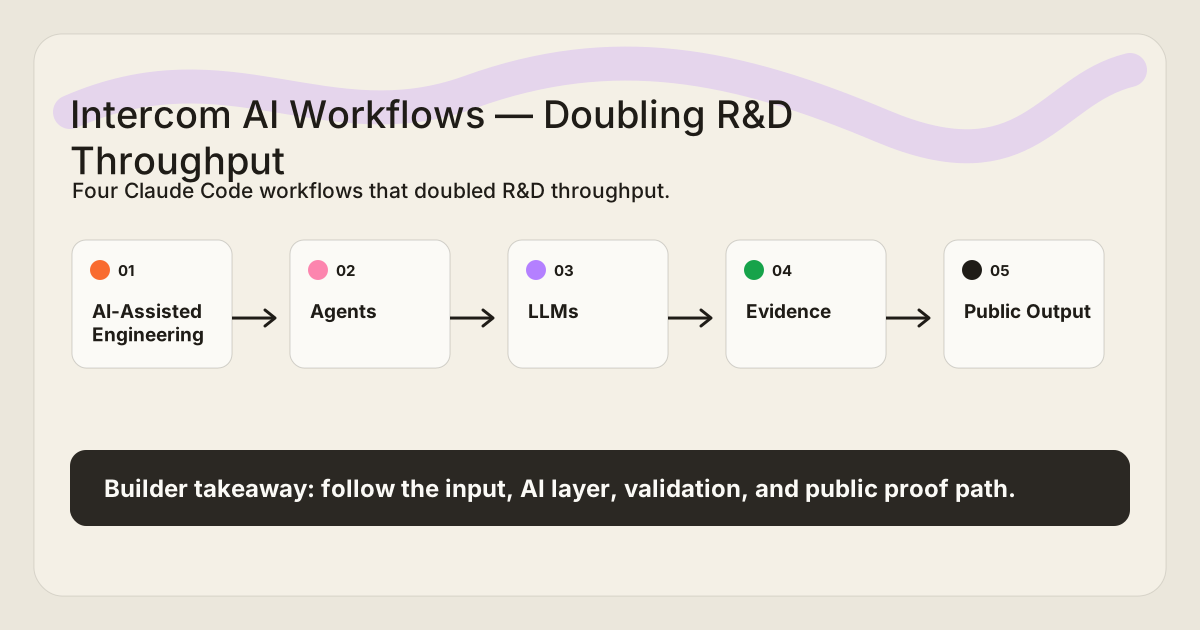
Intercom AI Workflows — Doubling R&D Throughput authored architecture diagram.
Metric · 01
Doubled R&D throughput across the engineering org
Metric · 02
Four production workflows in active service
01 / Showcase Signal

What this showcase helps explain.

Intercom turned AI coding from individual experimentation into four production workflows that doubled R&D throughput across the engineering org.

  • Doubled R&D throughput across the engineering org
  • Four production workflows in active service
02 / Architecture

How the system is put together.

Intercom AI workflow lanes from intake to Claude Code execution, review, and shipping.

The system is less a single agent than a repeatable operating model: identify high-volume engineering work, wrap it in a constrained workflow, and let Claude Code operate inside reviewable lanes. Human engineers stay responsible for intent, review, and merge decisions, while the AI handles repetitive implementation and cleanup work.

The interesting move is organizational. Instead of measuring AI by isolated prompt wins, Intercom treated each workflow as production infrastructure: scoped input, model-assisted execution, review checkpoints, and throughput reporting. That makes the workflow teachable to other teams rather than dependent on one unusually effective prompter.
03 / Walkthrough

The reproducible pattern.

01

Choose repeatable engineering work

Start with tasks that already have clear review standards: tech-debt cleanup, migration chores, tests, bug triage, or narrow implementation requests.

Workflow candidate checklist:
- Repeats every week
- Has clear acceptance criteria
- Can be reviewed in a pull request
- Fails safely when rejected
02

Package context for Claude Code

Each workflow gives the agent a bounded target, relevant files, success criteria, and the expected review artifact.

Task brief:
Goal: <one outcome>
Allowed files: <paths>
Done when: <tests/checks>
Return: PR summary + risks + verification
03

Review output like production code

The human loop is explicit: inspect the diff, require tests, reject weak changes, and feed the pattern back into the next workflow iteration.

04 / Stack

What it leans on technically.

Tool Version Role Why this tool
Claude Code Current Code execution Works directly in a repo and can produce reviewable diffs instead of detached suggestions.
Workflow templates Current Orchestration Turns individual AI use into repeatable team practice.
Pull requests Current Quality gate Keeps AI output inside the same review surface as human code.
Throughput metrics Current Evaluation Measures whether workflows actually change delivery, not just demo well.
05 / Prompts

Copyable prompt surfaces.

Workflow task frame

SystemYou are a repo-local engineering agent. Make the smallest change that satisfies the task and leave a reviewable trail.

User templateImplement <workflow task>. Stay inside <allowed paths>. Verify with <checks>. Return summary, risks, and follow-up work.

06 / Evidence

Artifacts you can inspect.

podcast episode ChatPRD How I AI articlehttps://www.chatprd.ai/how-i-ai/how-intercom-doubled-engineering-output-brian-scanlan-ai-workflows-for-claude-code Available
07 / Privacy & Evidence Boundary

What the public material does and does not expose.

Privacy. Public discussion on the How I AI podcast; specifics drawn from public episode content.

08 / Next Step

Use this showcase as brief context.