AI Atlas Talent Network
AI Atlas / Steve Kaliski / AI Minions — Slack-to-PR at Stripe
AI Atlas is a curated AI-native talent network.

This showcase is supporting context for the network: it helps people discover the talent area and see what a similar AI-native builder might be able to ship.

Request talent
Public showcase · Engineering Delivery · Operations Automation · Support Triage & Admin Workflows

AI Minions — Slack-to-PR at Stripe.

AI agents at Stripe that transform Slack messages into code changes, shipping roughly 1,300 pull requests per week from team conversations to production.
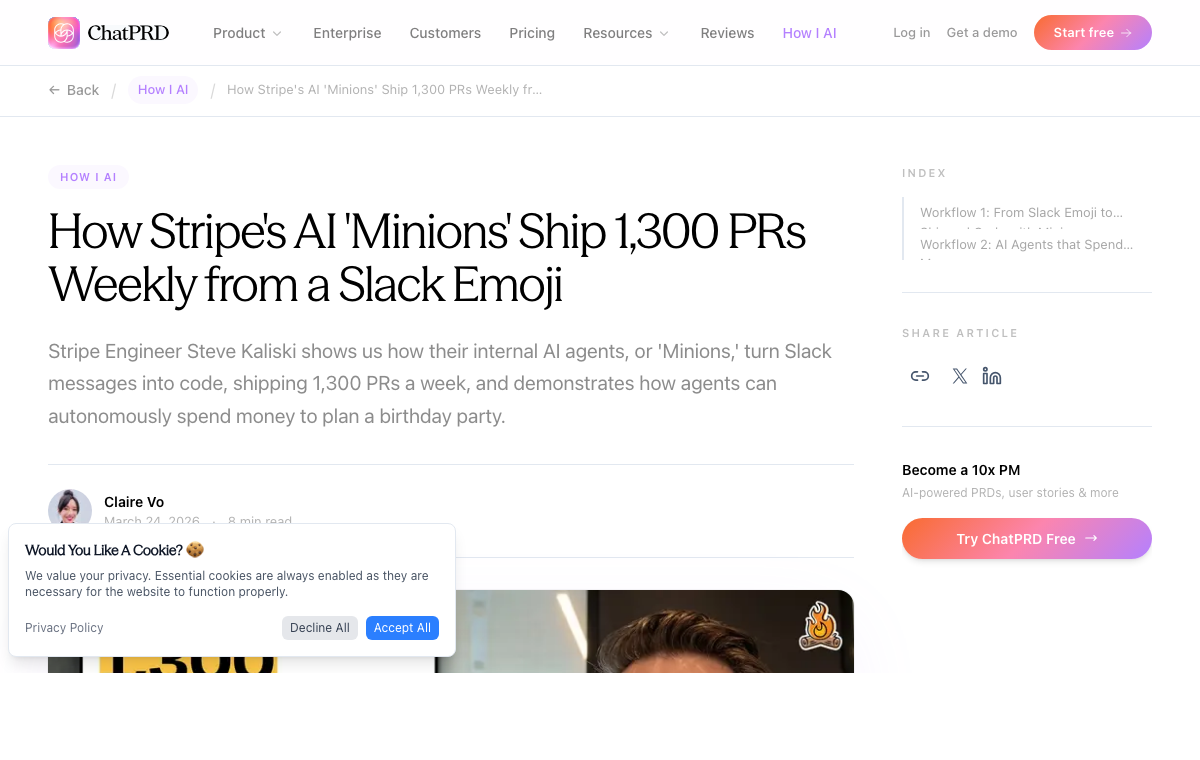
Live Artifact · 01 AI Minions — Slack-to-PR at Stripe captured proof view. screenshot
AI Minions — Slack-to-PR at Stripe captured proof view.
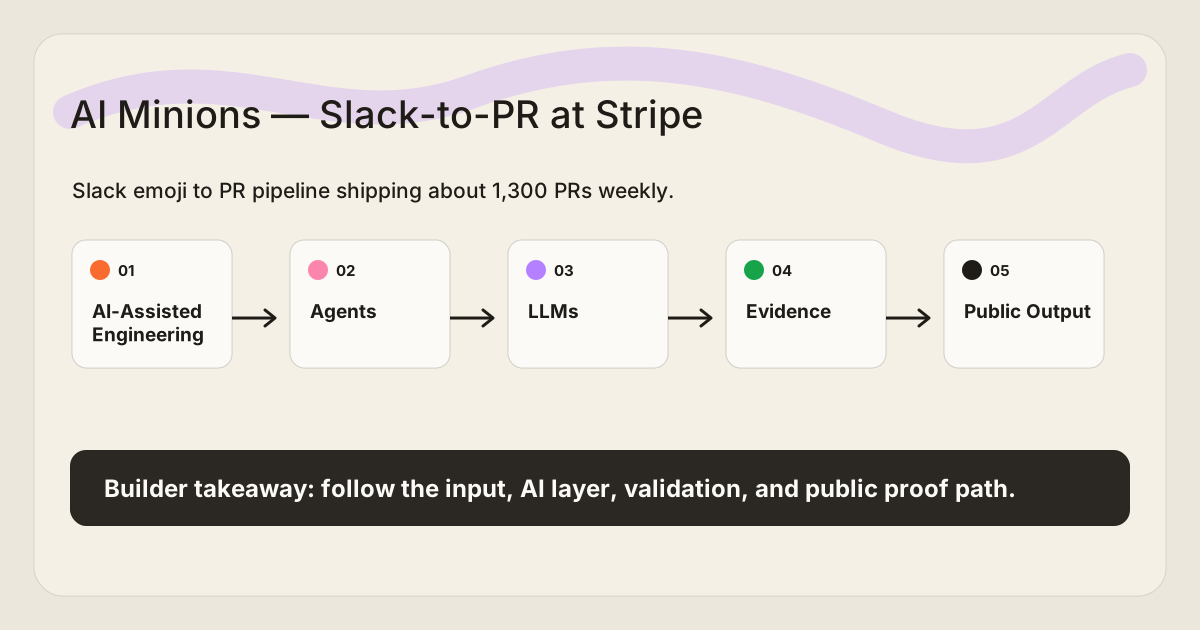
AI Minions — Slack-to-PR at Stripe authored architecture diagram.
Metric · 01
~1,300 PRs shipped per week from Slack-driven AI agents
01 / Showcase Signal

What this showcase helps explain.

A Slack reaction became an agent trigger: Stripe engineers could summon AI minions that pick up bounded engineering tasks and turn them into reviewable pull requests.

  • ~1,300 PRs shipped per week from Slack-driven AI agents
02 / Architecture

How the system is put together.

Stripe AI Minions workflow from Slack emoji through task routing, agent execution, pull request, and review.

The signature pattern is a low-friction trigger paired with serious delivery controls. An engineer signals intent in Slack, the system extracts or routes the task, and an agent executes against repository context until it has a pull request worth reviewing.

The magic is not that Slack can start an agent. It is that the interface lowers task capture to almost zero while the output still lands in the normal engineering quality system: pull requests, tests, and human review. That is how the workflow can scale without turning into a side channel.

03 / Walkthrough

The reproducible pattern.

01

Capture intent where work appears

Use Slack as the intake surface so engineers do not leave the conversation to create an AI task.

const task = {
  trigger: "slack_reaction",
  threadUrl,
  requester,
  repository,
  acceptanceCriteria
};
02

Route only bounded work to agents

The workflow should reject vague or high-risk requests and send only reviewable tasks to the coding agent.

03

Make pull requests the handoff

A successful minion run creates a PR with tests, summary, and reviewer context instead of silently changing production behavior.

04 / Stack

What it leans on technically.

Tool Version Role Why this tool
Slack Current Intake Makes starting an AI task as cheap as reacting in the conversation where work is discussed.
Coding agents Current Execution Transforms small tickets into concrete repo diffs.
GitHub pull requests Current Review surface Preserves ownership, traceability, and existing engineering controls.
CI checks Current Validation Keeps agent output accountable to the same gates as human-authored code.
05 / Prompts

Copyable prompt surfaces.

Slack-to-PR task prompt

SystemYou convert a bounded engineering request into a small pull request.

User templateFrom this Slack thread, infer the task, inspect the repo, implement the smallest fix, run checks, and prepare a PR summary.

06 / Evidence

Artifacts you can inspect.

podcast episode ChatPRD How I AI articlehttps://www.chatprd.ai/how-i-ai/stripes-ai-minions-ship-1300-prs-weekly-from-a-slack-emoji Available
07 / Privacy & Evidence Boundary

What the public material does and does not expose.

Privacy. Public discussion on the How I AI podcast; specifics drawn from public episode content.

08 / Next Step

Use this showcase as brief context.